
ArticlesNo Comments

Introduction
India is preparing to make history with Gaganyaan, the nation’s first human spaceflight program developed by the Indian Space Research Organisation (ISRO). The mission aims to send Indian astronauts – called Vyomnauts – into space aboard an indigenously developed spacecraft, marking India’s entry into the elite group of nations capable of human spaceflight.
But what exactly makes the Gaganyaan mission possible? Let’s explore its two key components – the Crew Module and the Launch Vehicle – and understand how they work together to ensure the safety and success of India’s human space journey.

1. Overview of the Gaganyaan Mission
Gaganyaan’s primary goal is to demonstrate India’s capability to launch humans into low Earth orbit (LEO) and bring them back safely.
- Orbit: ~400 km above Earth
- Mission Duration: 3 days in space
- Crew: Up to 3 astronauts
- Objective: To validate life-support, safety, and recovery systems for future human and long-duration space missions.
Before the actual crewed launch, ISRO is conducting several uncrewed test flights – including Gaganyaan TV-D1 and TV-D2 – to test the abort system, parachutes, and other safety mechanisms.
2. The Crew Module — India’s Spacecraft for Humans
The Crew Module (CM) is the heart of the Gaganyaan mission. It is the pressurized capsule where astronauts live, work, and return safely to Earth.
Key Features
- Shape & Structure:
- Conical shape with a blunt heat shield bottom.
- Designed to withstand extreme re-entry conditions and maintain structural integrity.
- Built using aluminum and composite materials for strength and weight optimization.
- Crew Capacity:
- Can carry three astronauts with full life-support systems.
- Includes ergonomically designed seats, control panels, and viewing windows.
- Life Support Systems:
- Provides oxygen, temperature control, and carbon dioxide removal.
- Features fire suppression and pressure maintenance systems for survival in orbit.
- Thermal Protection System (TPS):
- The base is covered with ablative heat shields to endure re-entry temperatures exceeding 1,600°C.
- Similar to those used in re-entry capsules like NASA’s Orion and Russia’s Soyuz.
- Recovery System:
- Equipped with parachutes and flotation devices to ensure a safe splashdown in the sea.
- The Indian Navy will perform post-landing recovery operations.
- Avionics & Control:
- Advanced navigation and guidance computers ensure autonomous flight and re-entry control.
- Redundant systems enhance safety in case of a component failure.

3. The Service Module (SM) — Power & Support
Attached below the crew module is the Service Module, which provides essential power, propulsion, and thermal regulation.
Key Systems
- Propulsion: Uses bipropellant engines for orbital maneuvers and attitude control.
- Power Supply: Solar panels and lithium-ion batteries supply energy to onboard systems.
- Cooling & Environment: Regulates internal temperature using radiators and coolant loops.
When the spacecraft prepares for re-entry, the Service Module detaches, and only the Crew Module re-enters Earth’s atmosphere.

4. The Launch Vehicle – LVM3 (GSLV Mk III)
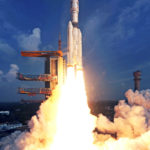
The Launch Vehicle Mark-3 (LVM3), also known as GSLV Mk III, is India’s most powerful rocket and the designated launcher for Gaganyaan.
Configuration Overview
- Core Stage (L110):
- Two Vikas liquid engines using UDMH and N₂O₄ propellants.
- Provides steady thrust during ascent.
- Boosters (S200):
- Two large solid rocket boosters deliver initial liftoff power (~5,000 kN each).
- Separate after ~140 seconds of flight.
- Cryogenic Upper Stage (C25):
- Uses liquid hydrogen (LH₂) and liquid oxygen (LOX).
- Provides the final velocity boost to place the spacecraft into orbit.
Human-Rating Modifications
The LVM3 has been “human-rated” – upgraded for astronaut safety:
- Redundant systems and sensors.
- Smoother acceleration profile.
- Additional quality and reliability checks.
- Integration with Crew Escape System (CES) for emergency rescue.

5. The Crew Escape System (CES) – Safety First
A vital safety feature of Gaganyaan, the Crew Escape System, ensures that astronauts can safely eject in case of a launch emergency.
- Powered by solid rocket motors that rapidly pull the crew module away from the rocket.
- Tested successfully in the TV-D1 test flight (2023).
- Ensures crew survival even during catastrophic booster failure.
6. Mission Sequence (Step-by-Step)
- Launch: LVM3 lifts off from Sriharikota carrying the Crew Module.
- Orbit Insertion: The rocket places the spacecraft in a circular orbit (~400 km).
- Crew Operations: Astronauts perform microgravity experiments and system checks.
- De-orbit Burn: Service Module engines slow the spacecraft for re-entry.
- Separation: Crew Module separates and enters Earth’s atmosphere.
- Re-entry & Deceleration: Heat shield protects the capsule during fiery descent.
- Parachute Deployment: Sequential parachutes open to slow descent.
- Splashdown: Capsule lands safely in the Bay of Bengal for naval recovery.

7. Future Vision – India’s Human Spaceflight Roadmap
The success of Gaganyaan will open the door to:
- Long-duration missions to space stations.
- Indian Space Station planned for the 2030s.
- Collaborative missions with international partners.
- Advancements in biomedical research, space robotics, and AI-based mission control.
Conclusion
The Gaganyaan mission represents a bold step forward for India’s space ambitions. Through innovation in crew safety, vehicle design, and indigenous technology, ISRO is building the foundation for future human exploration – from orbit to the Moon and beyond.
India’s journey to human spaceflight is not just about reaching the stars — it’s about proving that the sky is no longer the limit.
Be the first to post a comment.