
Every time a plane takes off, flies, and lands safely, there’s an invisible guardian guiding its every move — Air Traffic Control (ATC).
ATC ensures that thousands of aircraft in the sky maintain safe distances, follow designated routes, and land smoothly even in the busiest airports or bad weather.
Let’s explore how ATC works, its different components, and the communication process between controllers and pilots – with clear diagrams to visualize the system.
Air Traffic Control (ATC) is a network of ground-based controllers who use radar, radio communication, and navigation data to manage the movement of aircraft both on the ground and in the air.
Main objectives:

ATC is divided into three main stages:
| Stage | Responsibility | Location | Controlled Zone |
|---|---|---|---|
| 1. Tower Control (TWR) | Handles aircraft on runways and nearby airspace | Airport tower | Surface → ~5 miles radius |
| 2. Approach/Departure Control (APP/DEP) | Manages aircraft during climb and descent | Regional ATC | Up to 50 miles |
| 3. Area Control Center (ACC) | Manages en-route flights between cities | Regional/National center | High-altitude airways |
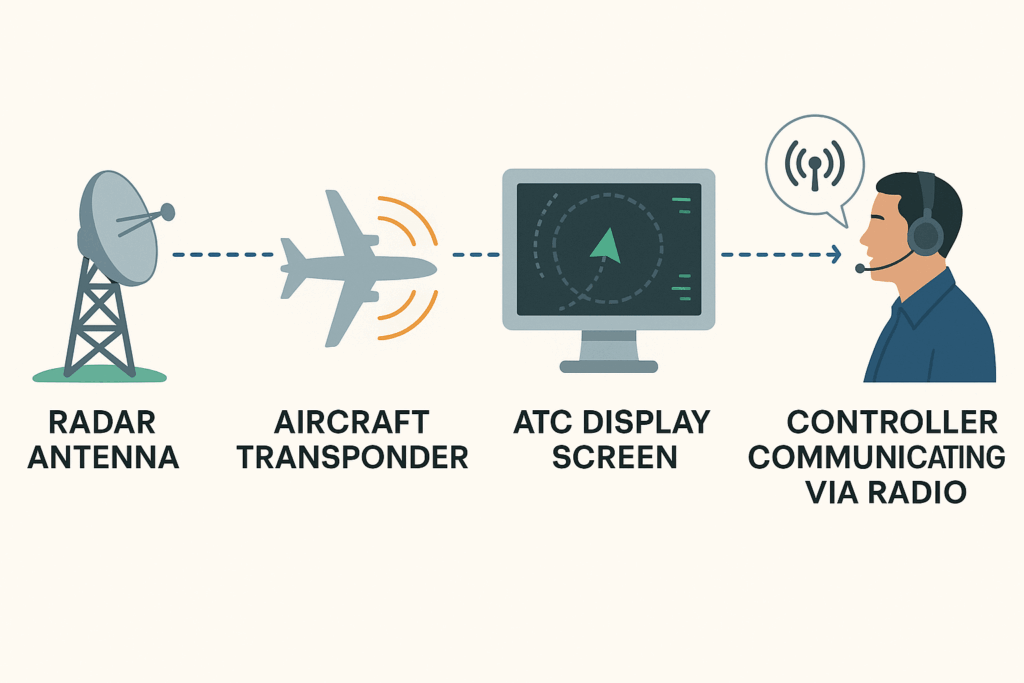
Key systems used:
Example exchange:
“Delhi Tower, AI102 ready for takeoff Runway 27.”
“AI102, cleared for takeoff Runway 27, wind 270 at 8 knots.”

| Flight Phase | Controlled by | Main Responsibilities |
|---|---|---|
| Pre-Flight | Clearance Delivery | Assigns route, altitude, and flight plan |
| Taxi & Takeoff | Ground & Tower Control | Manages taxiways and runways |
| Climb & Cruise | Area Control Center | Monitors en-route path and separation |
| Descent & Approach | Approach Control | Guides aircraft toward runway |
| Landing & Taxi | Tower & Ground Control | Coordinates runway exit and gate arrival |

ATC maintains minimum separation to avoid collisions:
Modern systems use Conflict Alert and TCAS (Traffic Collision Avoidance System) to warn both ATC and pilots.

Inside, controllers sit at multi-screen consoles that show:
Each controller has a headset for real-time communication with pilots and other control units.
ATC also provides weather updates, reroutes aircraft during storms or turbulence, and coordinates emergency landings.
Modern ATC is evolving toward automation through:
The next generation system, NextGen (U.S.) and SESAR (Europe), aims for:
Air Traffic Control is the backbone of safe aviation.
From the moment a plane pushes back from the gate until it lands hundreds of miles away, ATC ensures every movement is precisely coordinated — keeping the skies safe, efficient, and organized.
You must be logged in to post a comment.

Be the first to post a comment.