Every aircraft in flight is constantly balanced between four fundamental forces – Lift, Thrust, Drag, and Weight. Understanding these forces is the foundation of aerodynamics, whether you’re designing a jetliner, flying a drone, or just curious about how airplanes stay in the sky.
In simple terms:
These four forces work together like a team — two help the airplane move and stay up, and two resist its motion.
The Four Forces of Flight
Imagine an airplane cruising through the air — draw a cross on it:
Upward Arrow → Lift
Downward Arrow → Weight
Forward Arrow → Thrust
Backward Arrow → Drag
When these forces are balanced, the airplane flies smoothly and level. Let’s break down each one.
1.Lift – The Upward Force
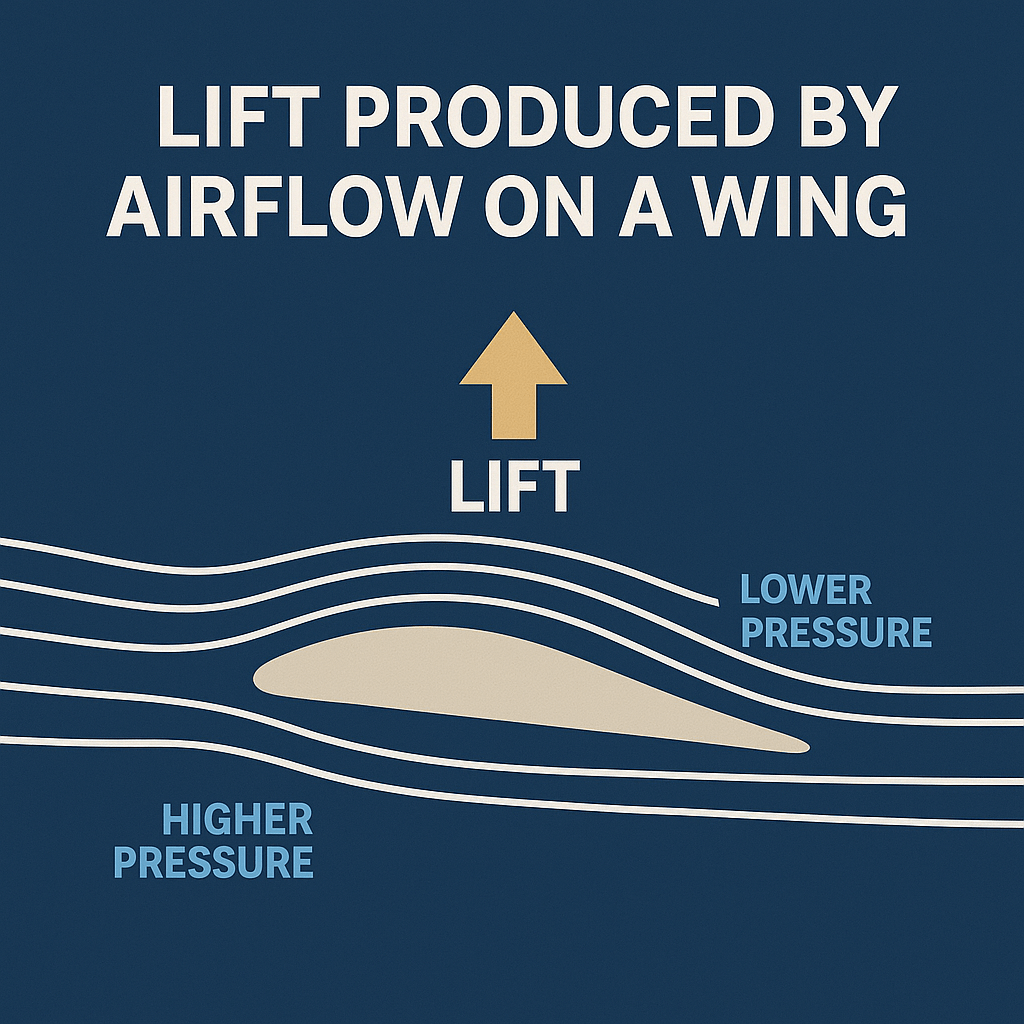
Definition: Lift is the upward force that opposes weight and keeps the aircraft in the air.
How it’s created: As air flows over and under the wings, the special curved shape (airfoil) makes air move faster on top and slower below. According to Bernoulli’s Principle and Newton’s Third Law, this speed difference creates a pressure difference, producing lift.
Key factors affecting lift:
Wing shape (airfoil design)
Angle of attack (tilt of the wing)
Airspeed
Air density
Simple Example: When you stick your hand out of a moving car window and tilt it slightly upward – you feel it lift. That’s the same principle of lift!
2.Weight – The Downward Force
Definition: Weight is the force of gravity pulling the aircraft toward the Earth.
What it depends on:
Aircraft mass (fuel, passengers, cargo, structure)
Gravity (which always acts downward through the airplane’s center of gravity)
Effect on flight: To climb, lift must be greater than weight. To descend, weight must be greater than lift.
3.Thrust – The Forward Force
Definition: Thrust is the forward-pushing force that moves the airplane through the air.
How it’s created: Engines (propellers, turbofans, or jets) push air backward — and by Newton’s Third Law (every action has an equal and opposite reaction) — the airplane moves forward.
Key sources of thrust:
Propeller aircraft: Engine spins blades to pull air backward
Jet aircraft: Engine expels exhaust gases at high speed
Rocket: Expels gases in vacuum to create thrust
Fun fact: A Boeing 777’s engines can each produce over 400,000 Newtons of thrust — enough to pull a loaded freight train!
4.Drag – The Backward Force
Definition: Drag is the air resistance that opposes thrust.
Types of drag:
Parasitic drag: Due to friction and the shape of the aircraft
Induced drag: Caused by lift (air swirling off the wing tips)
Reducing drag:
Streamlined shapes
Smooth surfaces
Winglets and aerodynamic fairings
Simple analogy: Running into a strong wind feels harder — that’s drag working against you.
Balance of Forces – The Key to Flight
When an airplane is flying straight and level, the four forces are in balance:
Force
Opposes
Balanced Condition
Lift
Weight
Lift = Weight
Thrust
Drag
Thrust = Drag
When the balance changes:
Lift > Weight → The plane climbs
Lift < Weight → The plane descends
Thrust > Drag → The plane accelerates
Thrust < Drag → The plane slows down
Real-World Examples
Aircraft
High Lift Example
High Thrust Example
High Drag Example
Glider
Efficient wings
Minimal thrust
Very low drag
Fighter Jet
Moderate lift
Extremely high thrust
High drag during maneuvers
Passenger Jet
Balanced lift & thrust
Efficient for cruise
Minimized drag for fuel economy
In Simple Words
Lift holds the airplane up. Weight pulls it down. Thrust pushes it forward. Drag pulls it backward.
An airplane flies when lift and thrust work together to overcome weight and drag.
Summary Chart
Force
Direction
Produced By
Opposed By
Lift
Upward
Wings
Weight
Weight
Downward
Gravity
Lift
Thrust
Forward
Engines/Propellers
Drag
Drag
Backward
Air Resistance
Thrust
Conclusion
The balance of Lift, Thrust, Drag, and Weight is what makes flight possible. From a paper airplane to a supersonic jet, the same principles apply. Mastering these forces is the first step toward understanding how aerodynamics governs the skies.
So the next time you see an airplane soar effortlessly – remember, it’s all a perfect dance of four simple forces working in harmony.



Be the first to post a comment.